Choosing an Industrial Chain Conveyor is rarely as simple as comparing prices or motor ratings. The right system must match your product, floor layout, operating speed, and maintenance capacity. A conveyor carrying hot castings needs different protection than one moving packaged food products. Chain type, flight design, frame material, and drive arrangement all influence performance.
Start with the load. Measure product weight, dimensions, surface condition, and spacing between items. Then examine the route, including inclines, transfers, washdown areas, and restricted access points. A practical evaluation should also consider chain tension, sprocket wear, guarding, noise, and emergency stops. These details often determine whether the conveyor runs smoothly or creates daily delays.
Real operating experience matters. Ask suppliers for test data, installation references, and clear maintenance intervals. If possible, inspect a similar conveyor in service. Watch how operators clean it, adjust the chain, and remove damaged components. Specifications can look impressive on paper. Reality is less polite.
Avoid choosing from catalog numbers alone. A higher load rating does not automatically mean better value. Oversized equipment may consume more energy and complicate repairs. Undersized equipment may suffer from stretch, shock loading, and premature failure. Your first assumptions may be wrong. Recheck them against peak loads, not average conditions.
This guide explains the main selection factors and the questions worth asking before purchase. It also highlights common design compromises, so your final decision remains practical, safe, and supportable over many years.
Start with three measurable values: load, throughput, and duty cycle. Load means the total weight carried by each chain attachment, pallet, or carrier. Include the product, fixture, and packaging. Throughput is the required movement rate, such as 12 carriers per minute. A practical first estimate is Capacity = Load × Rate.
Keep the units consistent.
Duty cycle describes how long and how often the conveyor operates. A line running eight hours continuously needs different performance from one running ten minutes per hour. Consider starts, stops, accumulation, inclines, temperature, and uneven loading. These details affect chain tension, motor heating, wear, and frame stiffness. The simple equation helps, but it is not complete. Real systems are rarely so tidy.
Tips: Measure actual product weight, not the catalog estimate. Record peak throughput during shift changes. Check whether the load sits centrally or pulls sideways. Add a reasonable design margin, but avoid excessive oversizing, which can increase cost and impact energy use. Test the heaviest product under the fastest planned rate. Review the calculation after installation; operators often reveal conditions missed during design. A conveyor can meet the average capacity and still fail during frequent starts. That is where careful observation matters.
Product data should guide conveyor design, not available floor space alone. Record product length, width, weight, base material, and center of gravity. Note fragile edges, unstable loads, and surface friction. A straight layout suits predictable flow and simple maintenance access. Curves, transfers, and elevation changes need extra testing. In practice, small dimensional changes can create large tracking problems. I once underestimated carton flex, and the transfer gap became the real bottleneck.
Tips: Convert product measurements into operating limits. Check the heaviest unit, not the average one. Keep loading points visible and reachable. Leave room for cleaning, inspection, and chain replacement. A practical layout is rarely the shortest layout.
Choose chain speed from throughput, spacing, and handling quality. Higher speed may reduce conveyor length, but it can increase impact, noise, and product movement. Test the actual product with the proposed chain and guide arrangement. For accumulation, define the required buffer in units and minutes. Zero-pressure accumulation can protect products, but it needs suitable controls and accurate sensing. Back-pressure zones are simpler, yet they may mark soft packaging. Do not assume one method fits every product. Validate stopping distance, restart behavior, and accumulation pressure under realistic conditions. The first calculation is only a starting point.
Choosing an industrial chain conveyor starts with the load, not the frame size. ISO 1977 and ANSI B29.18 provide dimensional and performance requirements for conveyor chains, attachments, and sprockets. Use the applicable standard to confirm pitch, roller diameter, link dimensions, and minimum breaking strength. Do not treat breaking strength as working capacity. A chain may fail long before its rated break load when shock, wear, or poor lubrication is present.
Calculate the chain pull from the conveyed mass, friction, conveyor angle, acceleration, and sprocket resistance. Then apply suitable service factors for impact loading and frequent starts. Compare the calculated working tension with the chain’s allowable working load listed in verified technical data. The selected chain should also match the sprocket tooth profile and engagement requirements under the chosen standard. Check speed carefully. High speed can increase vibration, heat, and lubrication loss.
Measure the real operating conditions. A dusty transfer point may need more protection than the original design suggests. I have seen apparently correct selections run poorly because the return strand sag was ignored. That detail matters. Keep the conveyor within the chain manufacturer’s stated limits, while checking compliance with ISO 1977 or ANSI B29.18 documentation. A spreadsheet helps, but it can still mislead when friction values are guessed. Recheck the result with actual load tests, alignment measurements, and inspection records before approving the final chain size.
| Data Dimension | Design Value or Requirement | Engineering Method or Rating Check | Selection Guidance |
|---|---|---|---|
| 1. Conveyor Operating Inputs | |||
| Conveyed mass, m | 1,200 kg in the worked example | Include product mass, pallets, fixtures, and the portion of chain-supported moving components. | Use the maximum operating mass rather than the average production load. |
| Conveyor length | 30 m in the worked example | Measure the loaded chain path. Include both loaded and return runs when calculating moving mass. | Long conveyors may require multiple drives, take-up provisions, or a higher chain working-load capacity. |
| Incline angle, θ | 0° in the worked example | Vertical component = m × g × sin(θ) | For inclined conveyors, include the complete elevation component in chain-pull calculations. |
| Conveyor speed, v | 0.25 m/s in the worked example | Confirm that the selected chain, sprocket, lubrication system, and drive can operate at the required speed. | Higher speed increases wear, impact frequency, centrifugal effects, and lubrication requirements. |
| Acceleration, a | 0.20 m/s² in the worked example | Acceleration force = m × a | Use the actual drive acceleration profile, including indexing or repeated starts and stops. |
| Estimated rolling or sliding resistance coefficient, μ | 0.08 in the worked example | Resistance force = μ × m × g × cos(θ) | Determine μ from the conveyor construction, bearing condition, guide material, lubrication, contamination, and load distribution. |
| Gravity constant, g | 9.80665 m/s² | Standard engineering conversion used for force calculations. | Keep units consistent; 1 kN = 1,000 N. |
| 2. Chain Pull and Design Load | |||
| Steady-state chain pull | Approximately 0.942 kN for the worked example | Fsteady = μ × m × g × cos(θ) + m × g × sin(θ) | For a horizontal conveyor, the elevation term is zero. |
| Acceleration chain pull | Approximately 0.240 kN for the worked example | Faccel = m × a | Include acceleration whenever the conveyor starts, indexes, or changes speed under load. |
| Peak operating chain pull | Approximately 1.182 kN for the worked example | Fpeak = Fsteady + Faccel | Evaluate starting, stopping, jam clearing, transfer impacts, and other transient conditions separately. |
| Application or service factor | 1.50 in the worked example | Fdesign = Fpeak × service factor | Use a higher factor for shock loading, frequent starts, poor lubrication, abrasive dust, contamination, or uncertain resistance. |
| Required design chain pull | Approximately 1.77 kN for the worked example | 1.182 kN × 1.50 = 1.773 kN | The selected chain’s published allowable working load must exceed this value after all applicable derating factors. |
| 3. Pitch, Sprocket, and Speed Screening | |||
| Candidate chain pitch | 50.8 mm, 63.5 mm, 76.2 mm, 101.6 mm, 127 mm, or 152.4 mm may be encountered in industrial conveyor chain series. | Verify the exact pitch, link dimensions, attachments, and sprocket geometry in the applicable ISO 1977 or ANSI B29.18 dimensional tables. | Do not substitute a chain from another series solely because the nominal pitch appears similar. |
| Pitch-line speed relationship | For a 50.8 mm pitch chain, 12-tooth sprocket, and 24 rpm: approximately 0.244 m/s | v = p × z × n ÷ 60 | Where p is pitch in metres, z is sprocket tooth count, and n is sprocket speed in revolutions per minute. |
| Sprocket tooth count | Use the applicable standard and manufacturer design range; avoid unnecessarily small sprockets. | Smaller sprockets increase articulation angle, polygonal action, bearing pressure, and chain wear. | Confirm that the chain series and sprocket tooth form are matched and compliant with the same dimensional system. |
| Chain centerline arrangement | Single-strand or multiple-strand design | Approximate load per strand = total design pull ÷ number of effective strands | Apply a derating allowance for unequal load sharing, shaft deflection, alignment error, and manufacturing tolerances. |
| 4. ISO 1977 and ANSI B29.18 Compliance Checks | |||
| Applicable standard | ISO 1977 or ANSI B29.18, selected according to the required chain series and project specification | Use one complete dimensional system for the chain, attachments, sprockets, and replacement parts. | ISO and ANSI chain series should not be treated as automatically interchangeable. |
| Chain pitch | Must match the specified standard series | Check nominal pitch and permitted dimensional tolerances. | A pitch match alone does not confirm interchangeability. |
| Roller or barrel diameter | Must match the selected standard series | Check compatibility with sprocket pockets, guide rails, and wear strips. | Incorrect roller or barrel dimensions can cause poor engagement and accelerated wear. |
| Inner width and attachment clearance | Must satisfy the chain and attachment dimensional tables | Verify side-plate clearance, attachment spacing, bolt clearance, and product envelope. | Allow sufficient clearance for contamination, thermal expansion, and chain articulation. |
| Sprocket tooth form and pitch diameter | Must correspond to the selected chain series | Check tooth profile, pitch, outside diameter, root clearance, and bore/keyway requirements. | Use matched chain-and-sprocket dimensions from the same applicable standard series. |
| Allowable working load | Must be greater than the calculated design chain pull | Allowable working load × derating factors ≥ Fdesign | ISO 1977 and ANSI B29.18 define dimensional and product requirements; they do not provide one universal working-load value for every chain construction. |
| Ultimate tensile strength | Use only as a reference for tensile failure resistance | Do not use ultimate tensile strength as the normal operating load. | Select by allowable working load, fatigue capability, wear performance, and the actual application—not by breaking load alone. |
| 5. Worked Selection Result | |||
| Calculated design pull | 1.773 kN | Based on 1,200 kg mass, μ = 0.08, θ = 0°, a = 0.20 m/s², and a 1.50 service factor. | Any candidate chain must have a published, derated allowable working load above 1.773 kN. |
| Candidate chain screening result | Accept only if the verified rating is > 1.773 kN | Confirm standard series, dimensions, attachment capacity, sprocket compatibility, speed, lubrication, and environmental limits. | If the rating is lower, select a larger chain, use more effective strands with verified load sharing, or redesign the drive arrangement. |
| Final engineering validation | Required before release for production | Check shaft torque, sprocket bore and key, shaft deflection, chain take-up, guide wear, guarding, lubrication, fatigue, noise, and emergency-stop loads. | Have the final selection reviewed against the current edition of the applicable standard and the chain supplier’s certified rating data. |
How to Choose an Industrial Chain Conveyor?
Calculate Drive Power with P = Fv and Apply Service-Factor Data
When selecting an industrial chain conveyor, calculate the actual resistance before choosing the drive. Start with the total effective force, F. Include chain friction, conveyed load, incline resistance, and acceleration. A horizontal conveyor carrying steel bins may need more force than its weight suggests. Dust, poor lubrication, and tight guides can increase resistance.
Use P = Fv, where P is power in watts, F is force in newtons, and v is speed in meters per second. For example, a 2,000 N effective pull at 0.3 m/s requires 600 W at the conveyor shaft. This is only the calculated running power. Divide by drive efficiency to estimate motor input power. Then apply the recommended service factor.
Service-factor data should reflect starts per hour, operating hours, shock loading, reversing, ambient temperature, and contamination. A conveyor running continuously under heavy impact needs a higher factor than one moving light cartons intermittently. Do not apply the largest factor automatically. Oversizing may increase cost, starting stress, and chain wear.
The calculation is not perfect.
Field conditions often differ from design assumptions. I have seen engineers underestimate buildup around sprockets and transfer points. Review the result with measured load data, chain-pull ratings, shaft torque, and motor starting capacity. Leave room for reasonable variation, but document every assumption. An accessible inspection point also helps verify whether the selected drive performs as expected.
Drive power is calculated using P = Fv, where F is the total conveyor resistance force in newtons and v is chain speed in metres per second. The design power applies a service factor to account for starting loads, shock loading, duty cycle, and operating conditions.
Design power = Calculated power × Service factor
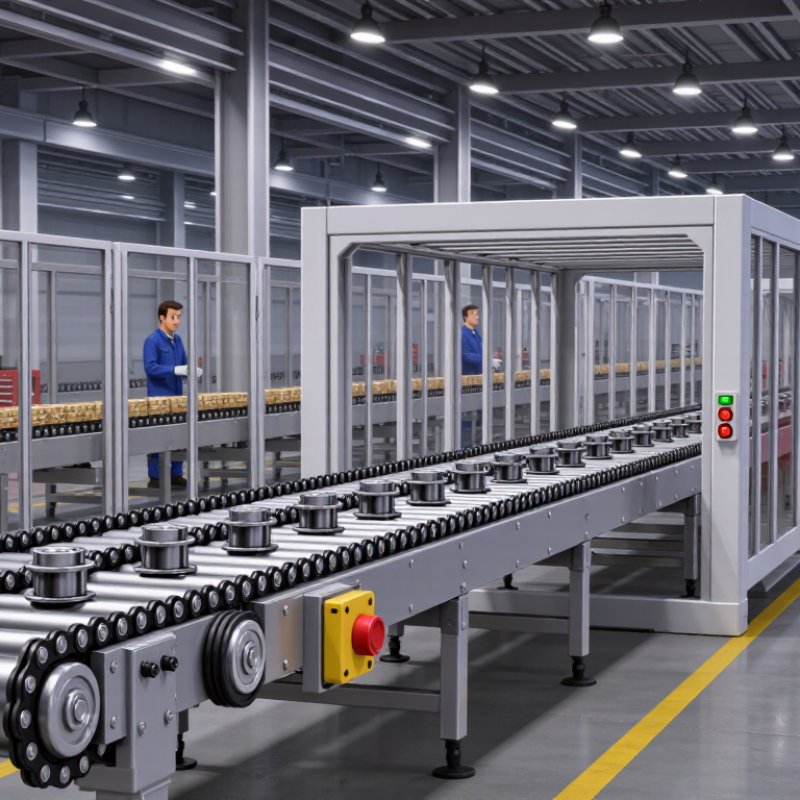
Guarding should be verified before capacity, speed, or price. ISO 12100 requires risk assessment across the conveyor’s lifecycle. Check nip points, sprockets, chains, and return strands. A hand should not reach moving parts through an opening. ANSI B20.1 also addresses guarding, emergency stops, accessible controls, and safe conveyor access. OSHA recorded 1,644 machine-guarding violations in its 2023 Top 10 list. That figure shows a persistent workplace risk, not a paperwork issue.
Wear inspection needs physical evidence. Look for elongated chains, hooked sprocket teeth, cracked flights, loose fasteners, and metal dust beneath the conveyor. Measure chain pitch against the manufacturer’s allowable limit. Record readings, photographs, lubrication dates, and rejected parts. Liberty Mutual’s 2023 Workplace Safety Index estimated $58.5 billion in serious workplace injury costs for 2021. Poor maintenance can become an expensive production problem. I would not trust a clean-looking conveyor without measurements.
Tips: Fit fixed guards where frequent access is unnecessary. Use interlocked guards only when risk assessment supports them. Test emergency stops during planned shutdowns, not during a crisis. Keep a short inspection route beside the conveyor. Mark one guarding gap that needs improvement, even if the system passes today. A checklist can still miss awkward access, poor lighting, or rushed maintenance. That is where the review should slow down.