Top 10 Types of Ceramic Laser Reflectors for Global Buyers?
Ceramic Laser Reflectors are quiet components with a demanding job. Inside a laser cavity, they redirect intense light while facing heat, chemical exposure, and repeated thermal cycling. Their performance can influence beam stability, energy efficiency, and service life. Global buyers therefore need more than a shiny surface. They need controlled reflectance, low contamination, suitable geometry, and dependable manufacturing records.
Dr. Takunori Taira, a respected solid-state laser researcher, offers a practical reminder: “Laser performance depends on controlling heat, not only generating light.” This principle shapes the comparison in this guide. Alumina reflectors may suit economical cavity designs. High-purity alumina can support cleaner optical environments. Zirconia, yttria, spinel, porous ceramics, glazed ceramics, and advanced composite structures provide different balances of reflectivity, hardness, and thermal behavior. Custom-machined forms can solve difficult alignment problems, although they usually increase lead time and cost.
The top ten types are not ranked by price alone. A reflector that performs well in a laboratory may disappoint in a dusty production line. Surface roughness, pore structure, coating adhesion, dimensional tolerance, and cooling conditions all matter. Ask for test data.
Small details decide outcomes.
Buyers should also review batch consistency, inspection methods, packaging, and export documentation. Beryllia-based products require especially careful industrial handling and qualified supply chains. The selection process is not flawless. Material names can hide major differences in purity and processing quality. That is why this overview compares practical use cases, technical trade-offs, and purchasing risks. It aims to help engineers, distributors, and procurement teams choose Ceramic Laser Reflectors with clearer evidence and fewer expensive assumptions.
Ceramic Laser Reflector Fundamentals: 1064–10,600 nm and >99% Reflectivity
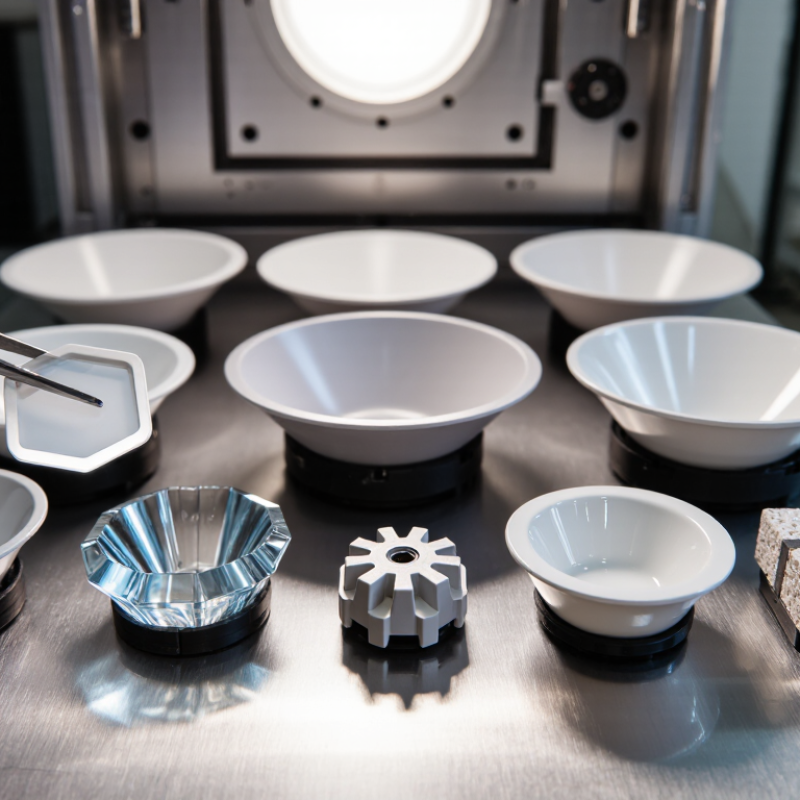
Ceramic laser reflectors support demanding optical systems from 1064 to 10,600 nm. The category includes dense alumina reflectors, zirconia-based parts, diffuse cavity liners, specular surfaces, and shaped pump reflectors. Their ceramic bodies tolerate heat better than many polymer components. They also resist deformation during repeated laser exposure. However, “greater than 99% reflectivity” is never a universal ceramic property. It depends on wavelength, coating design, surface finish, incidence angle, and polarization.
At 1064 nm, multilayer dielectric coatings can deliver extremely high reflection with carefully controlled thickness. At 10,600 nm, the coating materials and substrate preparation must change for infrared transmission behavior. One reflector rarely performs equally well across both ranges. That distinction matters. Buyers should request measured curves, not a single headline percentage. Ask for data at the working angle, temperature, beam size, and power density. Integrating-sphere tests help with diffuse reflection, while calibrated laser measurements suit specular surfaces.
Thermal stability remains central in industrial selection. A reflector may look flawless before testing, then develop coating stress after thermal cycling. Inspect edge chipping, flatness, roughness, and mounting distortion. A perfect number is rarely practical. I would also question whether the stated value represents initial performance or long-term performance. Clear inspection records, batch traceability, and independent test reports make technical comparisons more reliable. For global buyers, dimensional tolerances and packaging protection deserve equal attention, especially when large ceramic surfaces travel through changing humidity and temperature.
This comparison presents ten ceramic laser reflector configurations commonly used for high-reflectivity optical systems. The values are representative nominal design targets for the stated wavelength region; actual performance depends on coating materials, layer count, angle of incidence, polarization, surface quality, and substrate preparation.
Ten Reflector Types by Ceramic, Coating, Wavelength, and Cooling Design
Top 10 Types of Ceramic Laser Reflectors for Global Buyers
Ceramic laser reflectors differ by substrate, coating, wavelength, and cooling design. The ten practical types include alumina, beryllia, zirconia, silicon carbide, dielectric-coated, protected-silver, protected-gold, ultraviolet, near-infrared, and actively cooled reflectors. Alumina suits cost-sensitive systems, while beryllia offers strong thermal conductivity. However, beryllia requires careful handling and controlled processing. Silicon carbide is attractive for high-power cavities because it combines stiffness with heat resistance. Zirconia can provide chemical stability, although its optical finishing may require tighter process control.
Coating choice defines reflectance, absorption, and service life. Dielectric stacks support narrow wavelength bands and high reflectivity. Protected metallic coatings offer broader coverage but may absorb more energy. For ultraviolet systems, coating durability matters more than a low purchase price. Near-infrared reflectors often require precise angle and polarization control. According to a 2024 MarketsandMarkets assessment, the laser technology market is projected to grow at roughly 8% annually through the decade, increasing demand for application-specific optics. That growth does not make every reflector interchangeable.
Cooling design is equally important. Air-cooled ceramic reflectors fit lower-duty optical paths. Conductive mounts suit compact equipment with stable heat sinks. Water-cooled channels support high average power, but seals, flow rate, and contamination need inspection. A 2024 Grand View Research report identifies industrial processing as a major laser market application. Field experience shows a common mistake: buyers specify peak power but ignore absorbed coating power. This can distort temperature estimates. Measure actual beam diameter, duty cycle, wavelength, and cooling capacity before approval. Sometimes, the “best” ceramic is simply the one that survives the measured thermal load.
Key Metrics: >99% Reflectivity, 1–30 W/m·K Conductivity, and Damage Thresholds
Top 10 Types of Ceramic Laser Reflectors for Global Buyers
Ceramic laser reflectors differ by substrate, coating, wavelength range, and cooling design. Common options include alumina, aluminum nitride, silicon carbide, zirconia, cordierite, and glass-ceramic constructions. Some designs combine ceramic bodies with multilayer dielectric coatings. Others use polished ceramic surfaces for specialized infrared systems. Buyers should request measured reflectivity at the exact operating wavelength, not a general catalog figure. A reflector rated above 99% may perform differently at 532, 1064, or 10.6 micrometers.
Thermal conductivity strongly affects alignment stability. Alumina commonly sits near the lower part of the 1–30 W/m·K range. Aluminum nitride and silicon carbide can provide much faster heat spreading. This matters near a focused beam, where a small hot spot can create coating stress. Ask for conductivity values at the intended temperature. Room-temperature data alone can mislead. It happens more often than expected.
Damage thresholds require even closer review. Suppliers should state fluence or power density, pulse duration, repetition rate, beam diameter, and test wavelength. A continuous-wave reflector may tolerate high average power, while a nanosecond pulse causes a different failure pattern. Inspect the test method and surface-quality specification. Tiny scratches can scatter energy and reduce service life. The impressive number is not the whole story. Real installation results may vary with cooling, contamination, incidence angle, and mounting pressure. A careful buyer leaves room for that uncertainty.
Top 10 Types of Ceramic Laser Reflectors for Global Buyers? - Key Metrics: >99% Reflectivity, 1–30 W/m·K Conductivity, and Damage Thresholds
| No. | Ceramic Reflector Type | Typical Substrate / Coating Configuration | Reflectivity at Design Wavelength | Thermal Conductivity
(W/m·K, 20–25°C) | Representative Laser Damage Threshold
(J/cm², 10 ns pulse) | Typical Advantages | Common Applications |
| 1 | Alumina Ceramic Reflector | High-purity Al₂O₃ with multilayer dielectric coating | 99.0–99.8% | 18–30 | 8–15 | Strong mechanical hardness, low cost, good dimensional stability | Industrial Nd:YAG systems, pump cavities, beam-turning mirrors |
| 2 | YAG Ceramic Reflector | Polycrystalline Y₃Al₅O₁₂ with high-reflectivity dielectric stack | 99.5–99.95% | 10–14 | 6–12 | Excellent optical homogeneity and low scattering when properly sintered | Solid-state laser resonators and high-reflectivity cavity optics |
| 3 | Sapphire Ceramic Reflector | Single-crystal Al₂O₃ with broadband or narrowband dielectric coating | 99.2–99.9% | 25–30 | 10–20 | Very high hardness, excellent UV-to-IR transmission, low absorption | UV lasers, metrology systems, harsh-environment beam steering |
| 4 | Yttria-Stabilized Zirconia Reflector | 3–8 mol% Y₂O₃-stabilized ZrO₂ with dielectric coating | 99.0–99.8% | 2–3 | 5–10 | High fracture toughness, thermal-shock resistance, and chemical durability | Compact laser modules and mechanically demanding reflector assemblies |
| 5 | Mullite Ceramic Reflector | 3Al₂O₃·2SiO₂ or alumina-rich mullite with dielectric coating | 99.0–99.7% | 2–6 | 4–9 | Low thermal expansion and good resistance to thermal cycling | Furnace-side optics and moderate-power industrial laser housings |
| 6 | Cordierite Ceramic Reflector | 2MgO·2Al₂O₃·5SiO₂ with protected dielectric reflector coating | 99.0–99.6% | 1.5–3 | 3–7 | Very low thermal expansion and good resistance to rapid temperature changes | Low-to-medium power optical fixtures and thermally stable supports |
| 7 | Steatite Ceramic Reflector | MgO·SiO₂-based steatite with enhanced dielectric mirror coating | 99.0–99.6% | 2–4 | 3–7 | Good electrical insulation, machinability, and economical production | Insulated laser mounts and low-to-medium power reflector modules |
| 8 | Forsterite Ceramic Reflector | Mg₂SiO₄-based ceramic with multilayer dielectric coating | 99.0–99.7% | 4–7 | 4–9 | Low dielectric loss, good thermal stability, and useful high-temperature performance | Industrial laser enclosures and high-temperature optical assemblies |
| 9 | Magnesium Aluminate Spinel Reflector | MgAl₂O₄ transparent or translucent spinel with dielectric mirror coating | 99.3–99.9% | 12–16 | 8–18 | High hardness, broad optical transmission, and good thermal-shock resistance | Broadband laser windows and high-energy beam steering optics |
| 10 | Aluminum Oxynitride Ceramic Reflector | AlON transparent ceramic with narrowband or broadband dielectric coating | 99.3–99.9% | 12–20 | 8–18 | High strength, wide infrared transmission range, and strong environmental durability | High-energy laser windows, defense optics, and infrared beam systems |
Technical notes: Reflectivity values are representative ranges for properly polished ceramic substrates with optimized dielectric coatings at the specified design wavelength; they are not intrinsic values of uncoated ceramics. Damage-threshold figures are indicative 10 ns, single-pulse ranges and can vary substantially with wavelength, coating design, surface quality, beam diameter, repetition rate, and test standard. Thermal-conductivity values are typical room-temperature ranges for dense materials and may vary with purity, porosity, crystal orientation, and manufacturing process.
Global Buyer Standards: ISO 10110, RoHS, REACH, and Lot Traceability
Top 10 Types of Ceramic Laser Reflectors for Global Buyers?
Ceramic laser reflectors may use alumina, zirconia, steatite, or glass-ceramic substrates. Their shapes include flat mirrors, corner reflectors, ring reflectors, conical reflectors, segmented reflectors, and custom apertures. Some designs use polished surfaces, while others combine ceramic bodies with deposited reflective coatings. The correct type depends on wavelength, beam size, thermal load, mounting stress, and required reflectance.
The drawing should reference ISO 10110 where applicable. This standard helps define surface quality, material data, coating areas, edges, and permitted defects. Do not accept a vague “optical grade” statement. Ask for measurable values, inspection methods, and acceptance limits. A reflector can look perfect under room light yet scatter a high-power beam. That detail is easy to miss.
RoHS and REACH documentation should identify restricted substances and relevant chemical concerns. Request current declarations, not copied files with unclear dates. Lot traceability should connect each part to raw material records, firing conditions, coating batches, inspection results, and final packaging. A visible lot code helps during incoming inspection. Keep photos of labels and measurements.
The list is not enough.
In practice, buyers should compare thermal expansion, flatness, coating adhesion, and cleanliness together. A low-cost reflector may pass visual inspection but fail after repeated heating cycles. I would also question certificates that show no test method or responsible sign-off. Standards improve confidence, but they do not replace technical judgment. Mistakes still happen. Clear records make them easier to find.