Top 10 Types of Trolley Elevators for Global Buyers

Moving loaded carts between floors can disrupt a workflow when routes are narrow, ramps are steep, or goods need controlled handling. A Trolley Elevator offers a dedicated way to transfer wheeled loads vertically, but the right design depends on the trolley, building, and daily operating pattern. Small details matter. Wheel dimensions, turning space, load balance, and stopping position can affect how smoothly a cart enters and exits.

This guide introduces ten common trolley elevator types for global buyers, from compact platform and hydraulic models to enclosed goods lifts and systems designed for repeated warehouse use. The categories may overlap: suppliers sometimes use different names for similar equipment. That distinction is easy to miss. Buyers should compare the actual configuration, not rely on a product label alone. Useful questions include whether the trolley rolls directly onto the platform, how doors and access points are arranged, and what happens during routine loading.

A reliable specification starts with measured site conditions and realistic load details. Record the trolley’s loaded weight, footprint, wheel layout, travel height, and expected trips per hour. Then review drawings, operating instructions, maintenance access, and relevant local requirements with qualified professionals. Product descriptions cannot replace a site assessment. Not every option fits every building, and a higher capacity does not automatically mean a better choice. The sections ahead explain the main types and the trade-offs buyers should consider before requesting quotations.
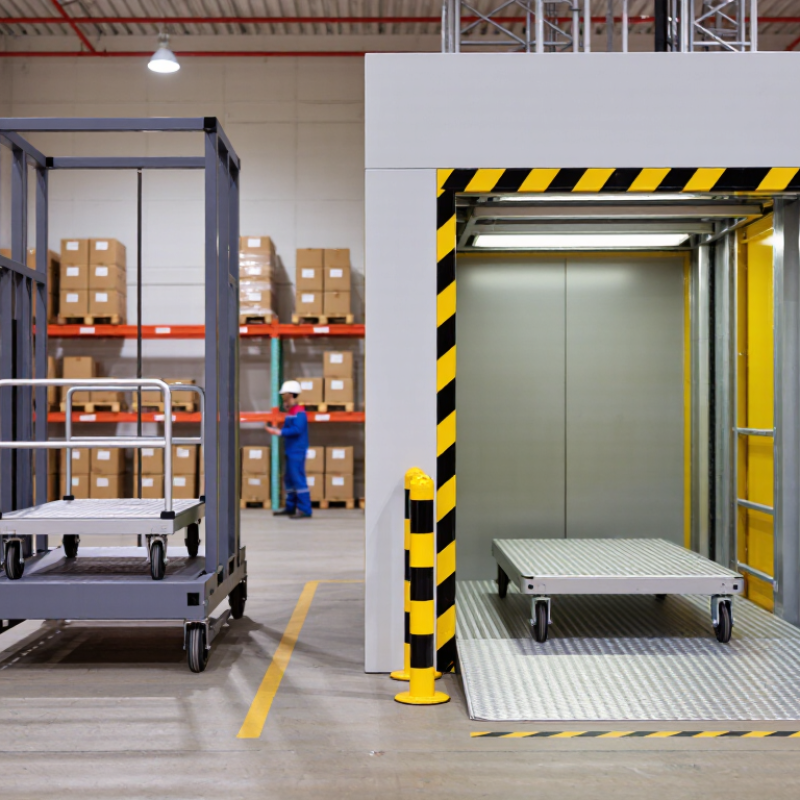
Top 10 Types of Trolley Elevators for Global Buyers

Define Trolley Elevators by Rated Load (kg), Car Size (mm), and Speed (m/s)

A trolley elevator should be specified by three figures: rated load in kilograms, clear car dimensions in millimetres, and rated speed in metres per second. ISO 4190-1:2010 lists passenger-lift load classes including 630, 1,000, and 1,600 kg. These offer useful comparison points, not ready-made trolley-elevator sizes. A wheeled cart can need more floor space than its weight suggests. Measure the cart, handles, and turning clearance before selecting the car. Small detail. Big consequence.

For example, a 1,000 kg rating does not guarantee that a loaded trolley will pass through the door or turn inside. Record usable car width, depth, and door opening separately. Then check the heaviest combined cart-and-goods load, including uneven loading. CIBSE Guide D: Transportation Systems in Buildings (2020) treats lift speed in relation to journey time and traffic demand; speed alone does not define handling performance. Short, frequent trips may suit a lower speed, while longer travel can justify a faster unit. Ask suppliers to state rated speed in m/s and confirm it under the intended load conditions. A specification can look complete on paper and still miss a protruding handle. I would recheck the measurements on site.

Top 10 Types of Trolley Elevators for Global Buyers

Representative rated loads, internal car sizes, and rated speeds for common trolley-elevator configurations.

Configuration Rated Load (kg) Internal Car Size (W × D, mm) Rated Speed (m/s)
Two-stop shop stock lift5001,200 × 1,5000.30
Light-duty service trolley lift3001,000 × 1,2000.30
Small goods trolley lift5001,200 × 1,5000.50
Cold-room goods lift1,0001,500 × 1,8000.30
Hydraulic goods trolley lift1,0001,500 × 1,8000.30
Warehouse pallet-trolley lift1,0001,500 × 1,8000.50
Traction goods trolley lift2,0002,000 × 2,5001.00
Automotive workshop trolley lift2,0002,000 × 3,0000.30
Industrial platform trolley lift3,0002,500 × 3,0000.50
Heavy-duty freight trolley lift5,0003,000 × 4,0000.50

How to read this: The chart compares representative rated-load examples; the table gives corresponding internal car dimensions and speeds. These are indicative planning values, not standardized specifications. Actual capacity and dimensions depend on the trolley, travel height, duty cycle, local codes, and project design. Confirm whether the stated rated load must include the trolley’s own weight.

Classify 10 Trolley-Elevator Types by Drive System and Installation Design

Buyers can classify trolley elevators by how the platform moves and how the unit fits the building. The categories can overlap: a compact lift may use an electric drive inside a shaft. The labels overlap.

Manual winch lifts suit occasional, low-capacity transfers where power is unavailable. Electric wire-rope models use a motor and sheaves, while electric chain models lift through a geared chain hoist. Direct-acting hydraulic lifts push the platform from below; indirect hydraulic units use ropes or chains routed over a cylinder. Screw-driven lifts travel along a threaded screw, and pneumatic models use air pressure in a sealed tube. Match the drive to rated load, travel height, and duty cycle.

Installation design creates three more useful types. An enclosed-shaft goods lift serves fixed landings, with doors and guides around its travel path. A guided-mast lift can suit open work areas, but needs a stable fixing surface. A pitless surface-mounted lift reduces excavation, though its approach ramp may complicate trolley handling.

Pit space matters. Check wheel width, turning clearance, floor strength, and service access. A tidy layout on paper can still feel awkward when a loaded trolley meets a narrow doorway.

Compare Hospital, Hotel, Retail, Warehouse, and Factory Trolley Applications

Hospital trolley elevators must move beds, meal carts, linen, and clinical supplies without disrupting busy corridors. Wide doors, smooth starts, accurate floor leveling, and easy-to-clean interiors matter. Noise matters, too. A trolley should enter without awkward turning, even when staff are tired or space is tight.

Hotels often prioritize discreet service movement. Housekeeping carts may need separate access from guest traffic, while catering trolleys carry hot trays between floors. Retail lifts face changing loads, from compact stock carts to seasonal displays. Clear door openings and dependable scheduling help staff restock without blocking customer routes. Peak periods can expose weak planning.

Warehouse and factory applications usually demand greater load capacity and frequent cycles. Warehouse trolleys may carry stacked cartons, so floor space, turning radius, and loading access deserve close checks. Factory carts can hold components or finished goods, sometimes with uneven weight distribution. That detail is easy to miss. Buyers should compare trolley dimensions, wheel type, payload, travel distance, and daily operating frequency against the actual route. A high capacity rating alone does not guarantee a good fit; site measurements and a realistic trial load can reveal problems before installation.

Match Door and Car Dimensions to Typical Goods-Lift Loads of 500–5,000 kg

A trolley elevator should be sized around the goods, trolley, and route—not load rating alone. Typical goods-lift capacities range from 500 to 5,000 kg, but a compact machine and a wide pallet can need very different car dimensions. Measure the largest trolley, including handles and any load overhang. Check the clear door opening, not just the stated door size.

Small detail. Big effect. A trolley handle that catches the jamb can undo an otherwise tidy layout. For loads around 500–1,000 kg, compact cars may work if the goods fit without awkward turning. Heavier loads, often in the 1,000–5,000 kg range, may need wider doors, more floor area, and stronger floor support. Exact dimensions depend on the lift design and how goods are loaded.

Allow clearance for operators, turning, and the landing threshold. Include the trolley’s own weight when checking the total load, and consider whether goods arrive on one trolley or several. A drawing can look right while a real pallet blocks the entrance. Test the proposed dimensions with the actual trolley and a simple floor plan before confirming specifications.

Top 10 Types of Trolley Elevators for Global Buyers - Match Door and Car Dimensions to Typical Goods-Lift Loads of 500–5,000 kg

Type Typical Rated Load Indicative Clear Car Dimensions (W × D × H) Indicative Clear Door Opening (W × H) Suitable Trolley or Goods Common Configuration
Compact hydraulic goods elevator 500–1,000 kg 1,400 × 1,200 × 2,100 mm 1,100 × 2,000 mm Small platform trolleys, boxed goods, and light stock carts Single-entry, suitable for shops, kitchens, and small storerooms
Standard hydraulic trolley elevator 1,000–2,000 kg 1,800 × 1,500 × 2,200 mm 1,400 × 2,100 mm Hand pallet trucks, roll cages, and general warehouse loads Single-entry, with a wide side-opening or sliding door
Traction freight elevator 1,500–3,000 kg 2,200 × 1,800 × 2,400 mm 1,600 × 2,200 mm Heavy carts, palletized goods, and frequent multi-floor deliveries Enclosed car; traction drive may suit taller buildings and higher travel
Pallet-truck goods elevator 1,000–2,000 kg 2,000 × 1,800 × 2,200 mm 1,600 × 2,100 mm Standard pallets moved by hand pallet truck Single-entry, with turning clearance checked against the pallet-truck layout
Roll-cage trolley elevator 500–1,000 kg 1,600 × 1,400 × 2,200 mm 1,300 × 2,100 mm Retail roll cages, linen carts, and catering trolleys Single-entry; door width should accommodate the cage and safe hand clearance
Through-car, double-entry goods elevator 1,000–2,500 kg 2,200 × 1,800 × 2,400 mm 1,600 × 2,200 mm at each end Long carts and loads that should travel straight through Opposite-side doors can reduce turning and handling at landings
Wide-car trolley elevator 2,000–3,000 kg 2,500 × 2,000 × 2,500 mm 1,800 × 2,300 mm Wide industrial carts, large crates, and bulky pallet loads Single-entry or through-car; check the largest load’s turning path
Heavy-duty industrial goods elevator 3,000–5,000 kg 3,000 × 2,500 × 2,800 mm 2,200 × 2,500 mm Heavy machinery carts, large pallets, and production materials Reinforced car and landing interfaces; loading method affects floor design
Multi-trolley warehouse elevator 2,000–4,000 kg 2,800 × 2,200 × 2,600 mm 2,000 × 2,400 mm Several roll cages or pallet trolleys carried in one trip Large car; plan the usable floor area and trolley parking arrangement
Temperature-controlled goods elevator 500–2,000 kg 1,800 × 1,600 × 2,200 mm 1,400 × 2,100 mm Insulated food carts, chilled goods, and temperature-sensitive supplies Insulated finishes and door seals may reduce usable internal dimensions

Dimensions and load ranges are indicative planning examples, not universal standards. Final specifications depend on the trolley footprint, loaded weight, door type, building layout, travel height, applicable local codes, and the elevator manufacturer’s engineering.

Check EN 81-20, ISO 8100-1, and ASME A17.1 for Global Compliance

Top 10 Types of Trolley Elevators for Global Buyers

Check EN 81-20, ISO 8100-1, and ASME A17.1 for Global Compliance

For trolley elevators carrying wheeled loads, compliance starts with the destination market—not the product label. EN 81-20, ISO 8100-1, and ASME A17.1 address lift safety, but they are not interchangeable approvals. Confirm which edition and amendments the local authority has adopted. Then check rated load, car and landing-door protection, clearances, emergency access, and inspection records. A loaded trolley must fit without striking doors or blocking controls. Small gaps matter.

Document the route from design review to commissioning. Keep test results, drawings, and maintenance instructions together; buyers and inspectors need evidence, not promises. The International Energy Agency’s 2023 Buildings report estimates that buildings account for about 30% of global final energy use. That figure is not elevator-specific, but it puts efficient operation in a wider context. Safety compliance comes first; energy use deserves its own review. Even a careful checklist can miss a local interpretation, so confirm details with qualified regional professionals.

Tips: Measure the largest trolley, including its handles and turning space. Ask suppliers for standard-by-standard compliance documents, not a single “global” claim. Verify local inspection steps before shipment. A tidy file helps, but it cannot replace an on-site check.

+1 450 449 9133
Contact us sale@rhythmachine.com